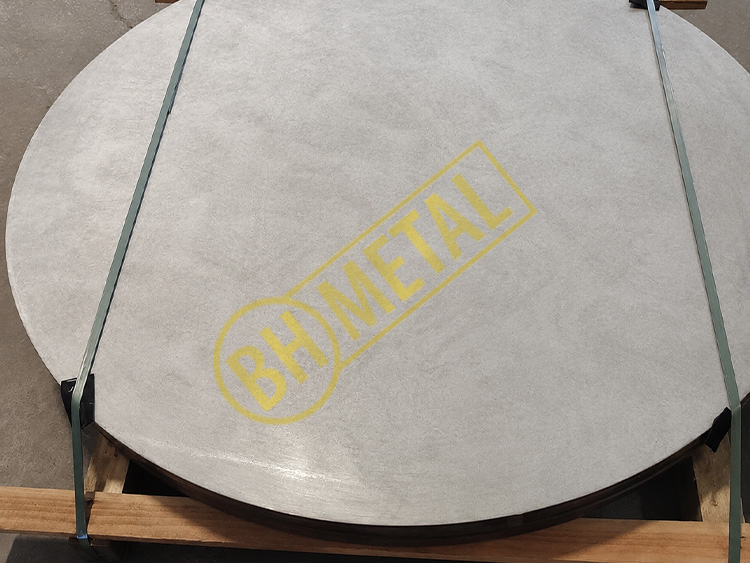
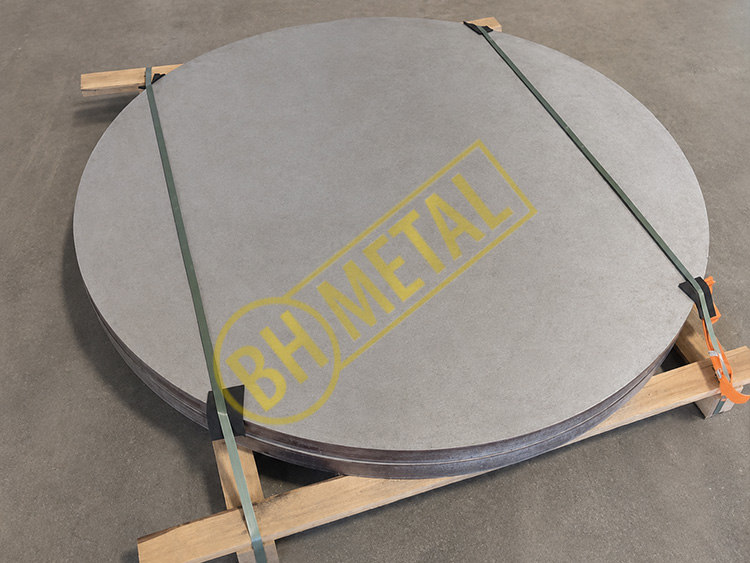
.png)

| Grade | Code | UNS | Austenitic Stainless Steel |
| AISI 317 | SUS 317 | S31700 |
AISI 317, with its higher molybdenum content, is an austenitic Cr-Ni-Mo stainless steel offering improved resistance to pitting, crevice corrosion, and many aggressive chemical environments compared with the AISI 316 family. Its approximately 3–4% molybdenum content strengthens localized corrosion resistance, while the chromium and nickel levels provide a balanced combination of general corrosion resistance, ductility, and formability. AISI 317 is particularly suited to chemical and petrochemical processing, pulp and paper equipment, heat-transfer equipment, and flue-gas treatment systems.
| C % | Mn % | Si % | P % | S % | Cr % | Ni % | Mo % | N % | Fe % |
| ≤0.08 | ≤2.00 | ≤0.75 | ≤0.045 | ≤0.030 | 18.00–20.00 | 11.00–15.00 | 3.00–4.00 | ≤0.10 | Balance |
| Form | Rp0.2 [MPa] | Rm [MPa] | Elongation [%] | Hardness [HB] | Density [g/cm³] |
| Plate | ≥205 | ≥515 | ≥35 | ≤217 | 8.03 |
| Sheet | ≥205 | ≥515 | ≥35 | ≤217 | 8.03 |
| Sector | Typical Products |
| Chemical & Process Industries | Chemical storage tanks, process tanks, reactor vessels |
| Petrochemical & Refining | Process vessels, heat exchangers, column and tower internals |
| Pulp & Paper | Digesters, process tanks, bleaching equipment |
| Energy & Flue-Gas Treatment | Wet scrubbers, flue-gas desulfurization equipment, absorber tanks |
| Heat Transfer / Industrial Process | Heat exchangers, condensers, evaporators |
| Chemical Transportation | Chemical tanker tanks, cargo tanks, corrosive-liquid storage tanks |
| Industrial Water / Wastewater | Process tanks, scrubbers, chemical dosing/storage tanks; service-specific selection |
AISI 317 does not eliminate the susceptibility of conventional austenitic stainless steels to chloride-induced stress corrosion cracking (SCC). Particular care is required when chlorides, tensile stress, and temperatures above approximately 49°C occur together. Prolonged exposure within the 427–816°C range can promote chromium-carbide precipitation and sensitization; for welded sections thicker than about 11 mm, post-weld solution annealing may be required depending on the corrosive service. In air, the alloy can show good oxidation resistance and relatively low scaling up to approximately 871–899°C; these temperatures should not be interpreted as recommended continuous-service or design temperatures. Solution annealing is typically carried out at approximately 1040–1175°C followed by sufficiently rapid cooling appropriate to the section thickness.
AISI 317, UNS S31700, ASTM Type 317, JIS SUS 317
| Form | ASTM / AMS |
| Plate | ASTM A240/A240M (S31700); AMS — |
| Sheet | ASTM A240/A240M (S31700); AMS — |
AISI 316/316L — the closest and most readily available lower-alloy alternative. Its molybdenum level is lower, so corrosion resistance is somewhat below that of 317, but commercial availability is generally much better.
AISI 904L — a higher-alloy upgrade for more aggressive chemical environments. Its Ni, Mo, and Cu contents are significantly higher.
254 SMO / F44 / 1.4547 — a strong upgrade for chloride-rich service where pitting and crevice corrosion are critical, offering performance above AISI 317.
Outokumpu – Ultra 317L product family (includes Type 317 / UNS S31700)
Note: The information contained in this datasheet is for informational purposes only; no liability is accepted.